Why AI Needs Structure
The Problem No One Talks About
AI is already part of most jobs—and if it's not yet, it will be soon. It removes friction. It shortens timelines. It lets small teams do things that once required entire departments.
But there's a problem we don't talk about enough: AI without structure creates messes.
Vague prompts, inconsistent output, features that work one day and break the next. Codebases end up littered with half-working "AI solutions" that someone eventually has to decipher and retarget. Even agentic workflows—which are impressive—start to feel risky once you move beyond small, repetitive tasks and into business-critical systems.
If you're a betting person, maybe you're comfortable with that. I'm not.
The Decision That Changed My Approach
To stay current, I made a goal: Every website or product I build going forward must include at least one core AI feature.
Not a chatbot, or demo. Real AI feature users actually depend on. That's when the cracks showed up in testing.
The typical approach—long natural-language prompts—doesn't hold up well in production. They drift. They hallucinate. Run the same prompt twice and you will get different structures back. That's fine for brainstorming. It's not fine when the output feeds core features.
What I needed was consistency.
From Prompts to Blueprints
The breakthrough wasn't "better prompting." It was structure. Instead of one long block of natural text, I wanted a single JSON blueprint—a file that contains everything the AI needs:
- Clear instruction sections
- Defined variables
- Rules and constraints
- Strict output schema
- Validation
- Many micro-shot examples (ultra-targeted)
Wire user input or data into that blueprint, send the compiled prompt to the LLM, and get back validated JSON you can actually work with.
No guessing. No brittle parsing. Fewer surprises. My time developing Shopify content showed how fast and solid JSON is. That's what I wanted in a prompt.
What a Master Prompt Is
A Master Prompt isn't a long natural text sentence. It isn't a manual local prompt-engineering time sink. It's a reliable single-feature blueprint.
Store it like code. Treat it as your AI feature Source of Truth. You version it. You reuse it. One Master Prompt per AI feature—focused, testable, and practical to ship.
The output is structured JSON data that can be rendered into reports, instructions, workflows, dashboards, or downstream systems, etc. The goal isn't magic—it's predictability. JSON is so fast and reliable, that is why most platforms and devs love it.
Once I started building this way, the AI features became easier to understand, output, and maintain.
Why I Didn't Keep This Internal
As I refined the approach, it evolved - from a weekend project to several weeks:
- Variables that couldn't be accidentally overwritten
- Stricter validation
- Metadata and tagging
- Many targeted examples I call micro-shot instead of bloated few-shot blocks
- Enough flexibility and content without losing contextual control
I experimented with chaining Master Prompts together using RAG-style flows. It worked, but in practice I preferred the clarity and cost control of one comprehensive Master Prompt per feature. For agentic workflows use smaller master prompts.
The main drawback was editing. Long structured prompts are powerful—but painful to maintain when they live as raw text.
So I built tooling to make them easier to create, edit, and test. So became CyWire.
What CyWire Is
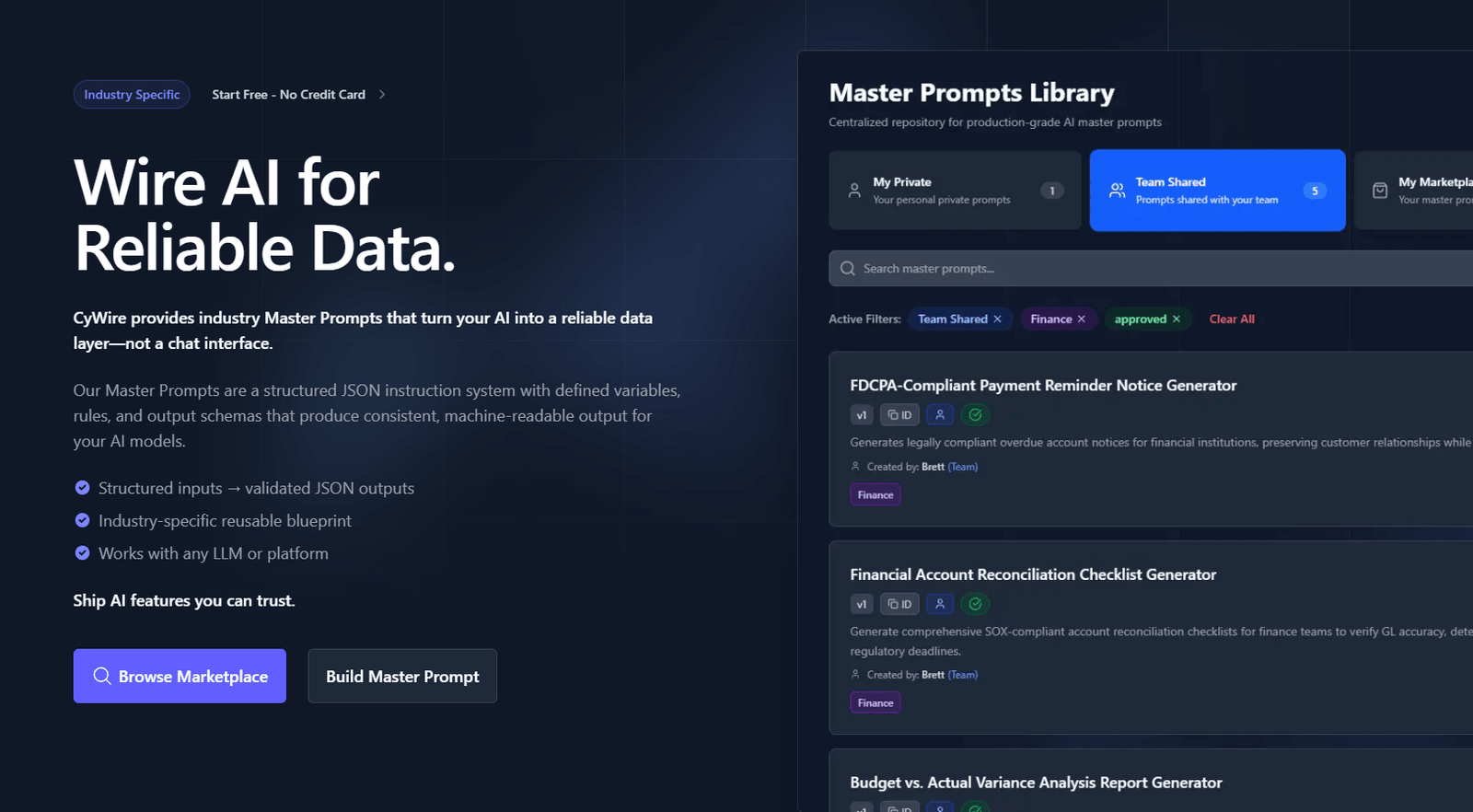
CyWire is a platform for building, testing, and providing Master Prompts. I decided an iterated one-off was not good enough, as I soon understood I needed it for all my future sites.
Not another AI chat UI. Not another API wrapper. Just wire AI for reliable data.
It's a way to design structured JSON blueprints for AI features—so they're easier to build, reason about, and maintain. You can build anything once you have structured data, just ask Shopify.
Product managers, analysts, content strategists, and designers, etc. can build, edit, and test a Master Prompt visually, then hand a solid JSON blueprint to a developer to wire up the compiled full prompt.
That's the vision.
What's in the Platform
I built and launched CyWire in three months, taking it from concept to production, refining the core engine through three major architectural versions along the way to reach the product vision above. It's built with Next.js, React, TypeScript, Tailwind CSS, Supabase, and Vercel.
Beyond the Master Prompt system itself, the platform includes:
- A no-code visual builder for creating and editing Master Prompts without writing raw JSON, with version control and collaborative editing on the full underlying code
- A community marketplace with free and premium Master Prompts, including industry-specific templates for healthcare, finance, manufacturing, and more
- A document-backed knowledge base supporting PDF, Word, and Excel uploads
- Labs, a Pro+ chat-based Master Prompt generator
- Authentication with tier-based access control across membership levels
- Scoped team workspaces for collaborative editing
- Dashboards and leaderboards for tracking usage and activity
Why This Matters
AI should be welcomed as a new tool to remove barriers, not to replace you. Not ending up with fragile systems, bloated natural text prompts, or vibed codebases no one wants to touch.
AI features need human orchestration.
They need structure.
They need boundaries.
Master Prompts aren't the future of AI.
Master Prompts are not a temporary solution for today's AI, they are a permanent requirement for tomorrow's. As models get smarter, they do not need fewer rules; they need clearer ones. Without enforced structure and guardrails, increased intelligence simply produces more confidently wrong output at scale.
Master Prompts lock intent, constraints, and output contracts in place, ensuring AI remains predictable, governable, and production-ready. They're a foundational necessity for building AI features that can actually hold up in production. That's why I built CyWire.
For the initial launch, I've shared many free, industry-specific Master Prompts in the CyWire community—use them as-is or adapt them for your own work. You have access to the entire master prompt code. Join as a free member, no credit card needed.
If you're building AI features that need to be reliable, not just interactive demos, this approach may work for you. For me, it only made sense.
Thanks for reading. Your thoughts are always appreciated.